

Summary:
The post explores the idea that chasing happiness as a foundation for life can be unstable because happiness is often tied to outcomes beyond our control. Instead, it suggests building a life grounded in peace, which is internal and stable, allowing for better decision-making and consistent outcomes. By maintaining peace through daily practices like intentions, gratitude, and forgiveness, individuals can create a life they don't need to escape from, where happiness becomes a byproduct rather than the goal. This shift from a reactive to an intentional, peace-based life changes how one experiences and interacts with the world.
If you could just get yourself into a place where you felt good—really good—then everything else would fall into place. Your health would improve. Your relationships would feel easier. Your work would click. Life would start to line up the way it’s supposed to.
It’s a clean idea. Simple. Easy to believe. Easy to chase.
And for a while, it works—at least enough to keep you convinced you’re on the right track.
It made sense… until it didn’t.
The Old Way of Thinking — Happiness First
The model was simple:
Happiness → Health, Wealth, Love
Feel good first… and everything else follows.
When you’re happy, you take better care of yourself. You make clearer decisions. You show up better for the people around you. You perform better, think better, live better.
It’s intuitive. It’s everywhere. And it gives you something to aim at.
Just get happy—and the rest will take care of itself.
The Problem — Happiness Doesn’t Hold
Here’s where it starts to break.
Happiness doesn’t show up on its own—it shows up because something went your way.
Things are working. Plans are clicking. Results are coming in.
That’s when you feel it.
But the moment something shifts… so does the feeling.
It fluctuates. Up when things are good. Down when they’re not.
And under pressure? It disappears fast.
Which means if happiness is your starting point, your entire system is tied to outcomes you don’t fully control.
And that’s a problem.
Because you can’t build something steady on something that moves.
The Pattern — The Energy of Being Average (and Not)
This isn’t about people—it’s about patterns.
Picture this…
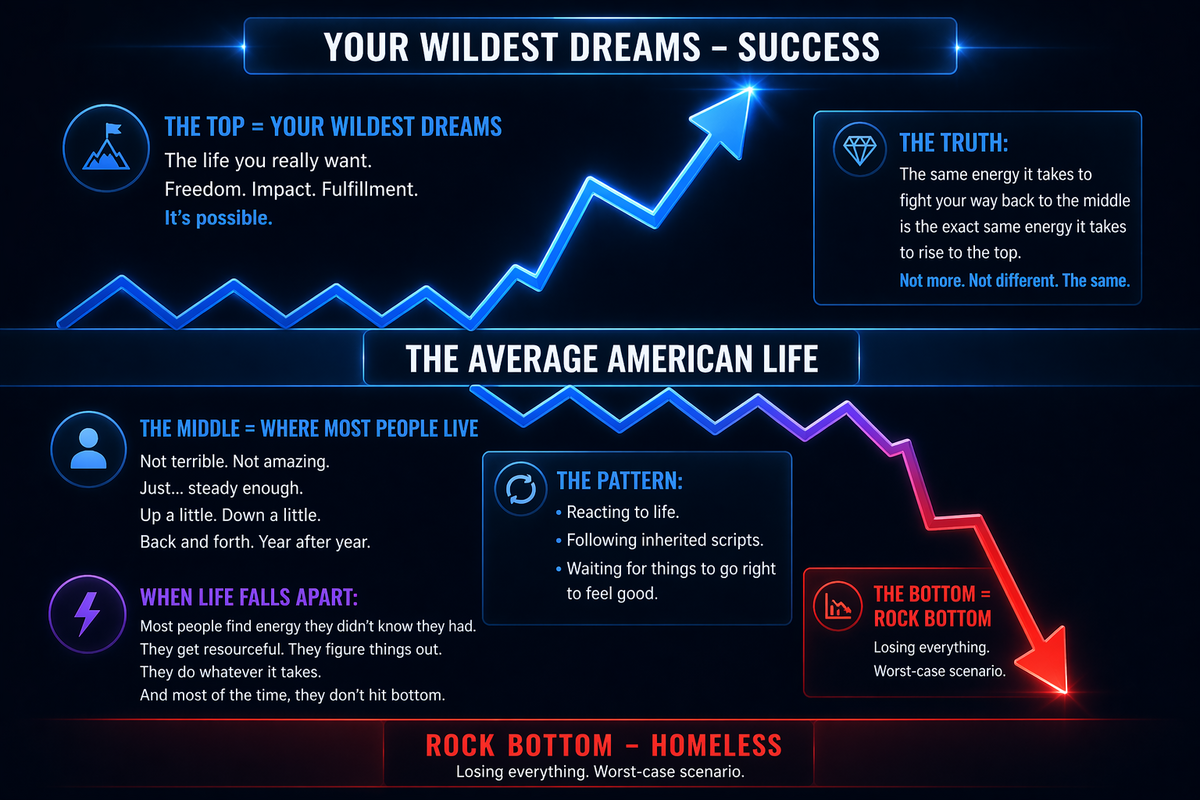
At the top of the graphic is a line moving upward—your wildest dreams, real success, the life you actually want.
At the bottom is the opposite—rock bottom. Losing everything. Worst-case scenario.
And right in the middle… is where most people live.
The Average American Life.
Not terrible. Not amazing. Just… steady enough.
A little up. A little down. Back and forth. Year after year.
Now here’s where it gets interesting.
When someone living in that middle lane starts slipping—when life begins to fall apart and that line starts moving toward the bottom—something happens.
They wake up.
They find energy they didn’t know they had.
They get resourceful.
They figure things out.
They do whatever it takes.
And most of the time?
They don’t hit rock bottom.
They pull it together. They stabilize. They fight their way back to the middle.
Which means something important is already true:
👉 They had the energy all along.
👉 They had the ability all along.
👉 They had the focus all along.
They just didn’t use it… until they had to.
And here’s the part most people never stop to think about:
The same energy it takes to fight your way back to the middle…
is the exact same energy it takes to go from the middle… to the top.
Not more.
Not different.
The same.
So the real question isn’t can people do it?
They’ve already proven they can.
The question is—
Why do most people only use that level of focus when they’re trying not to fall…
instead of using it to rise?
Most people aren’t choosing their life… they’re repeating it.
The Realization — Happiness Keeps You Reactive
Once you see the pattern, something clicks.
If happiness depends on outcomes…
and outcomes are unpredictable…
then your state is always tied to what just happened.
Things go your way—you feel good.
They don’t—you don’t.
So you adjust. React. Regroup. Repeat.
And without realizing it, you stay locked in that same loop—
responding to life instead of directing it.
Because when happiness is the trigger…
reaction becomes the pattern.
The New Thinking — Peace Over Happiness
At some point, the question changes.
If happiness can’t hold… what can?
That’s where the shift happens.
Peace.
Not as an idea—but as a foundation.
Peace isn’t something you wait for.
It isn’t something you earn after things go right.
And it doesn’t disappear the moment they don’t.
It’s internal.
It’s stable.
And it’s not tied to outcomes.
It’s something you maintain.
Which means instead of your state rising and falling with what happens around you…
you stay grounded, and make decisions from there.
Happiness is a reaction.
Peace is a position.
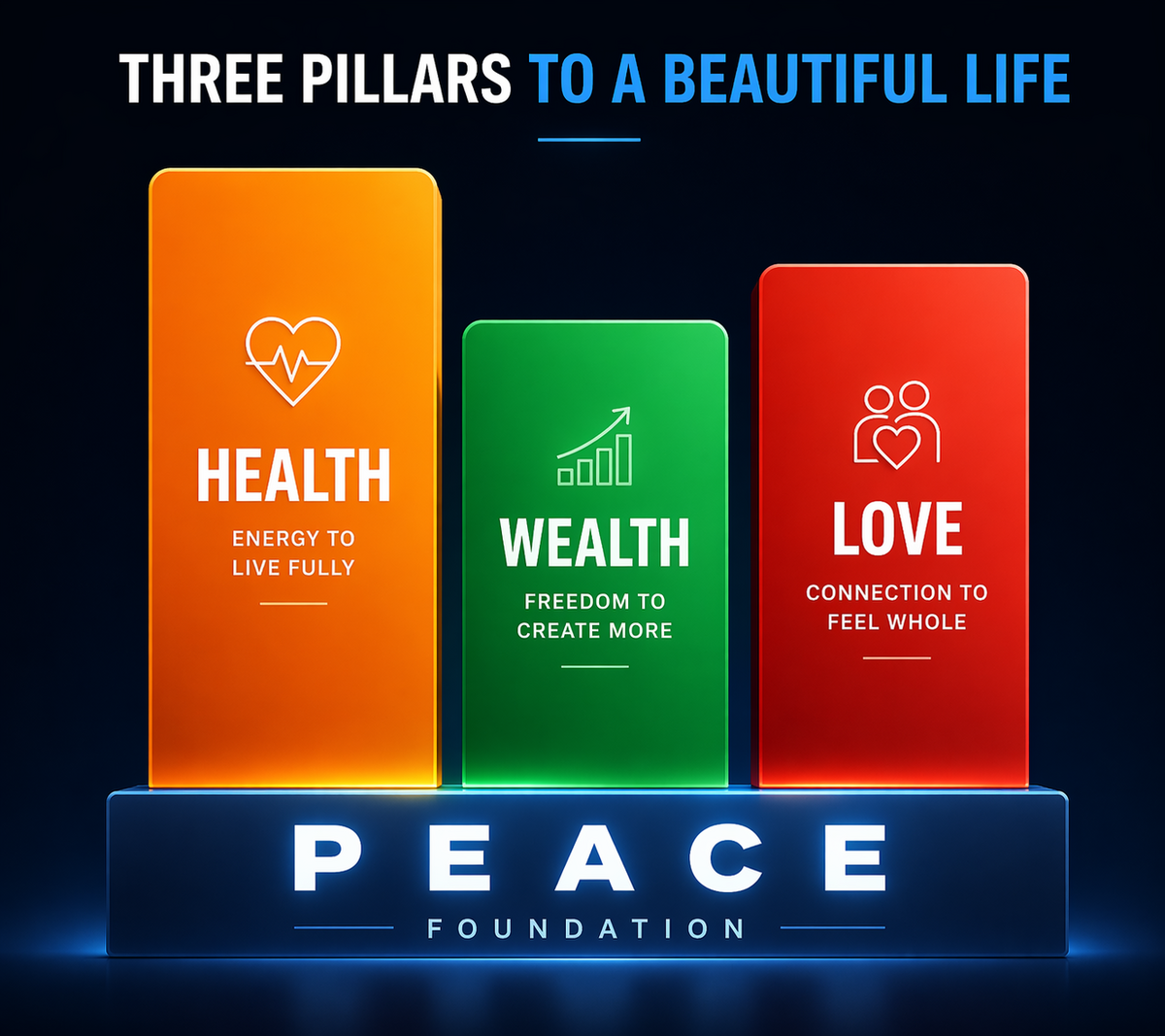
The New Model — Peace → Health, Wealth, Love
The structure doesn’t change. The foundation does.
Peace → clarity
Clarity → better decisions
Better decisions → better outcomes
That’s the flow.
When you’re not being pulled around by how things are going, you think clearer.
When you think clearer, you choose better.
And when you choose better—consistently—your outcomes start to reflect it.
That shows up everywhere.
Health becomes about consistency, not motivation.
Wealth becomes about discipline, not emotion.
Love becomes about presence, not reaction.
Same pillars.
Stronger foundation.
The Practices — How Peace Is Maintained
Peace doesn’t just happen.
It’s maintained.
And this is where the work actually lives—not in chasing a feeling, but in building habits that keep you steady regardless of what’s happening around you.
For me, it comes back to three simple anchors:
👉 Intentions
👉 Gratitude
👉 Forgiveness
Not as ideas… as daily practices.
Intentions keep you aligned.
They give direction to your actions before the day pulls you in a dozen different directions.
Gratitude keeps you grounded.
It shifts your focus from what’s missing to what’s already there—so you’re not constantly operating from lack.
Forgiveness keeps you free.
Free from past mistakes, resentment, and the mental weight that quietly drains your energy.
These aren’t tools to feel good.
They’re tools to stay steady.
Because when you’re aligned, grounded, and free…
peace becomes something you carry, not something you chase.
These aren’t about chasing a feeling—they’re about maintaining a state.
The Un-Retired Life
This is where it all connects.
The Un-Retired Life was never about escaping work.
And it’s not about chasing happiness either.
It’s about building a life you don’t need a break from.
A life where you stay in motion—creating, building, experiencing—because you want to, not because you’re trying to get somewhere else.
For a long time, it was easy to think the goal was happiness.
Work toward it. Build toward it. Eventually arrive there.
But that mindset quietly keeps you chasing.
The shift is this:
Not pursuing happiness…
but building from peace.
Because when you’re grounded first, the work changes.
The pace changes.
The way you experience everything changes.
You’re not trying to escape your life anymore.
You’re actually living it.
The Contrast — Default vs Designed Life
Once you see it, the difference is obvious.
The default pattern:
Reactive.
Outcome-driven.
Happiness-dependent.
Repeating the same cycles, just with different details.
You wait for things to go right so you can feel right.
And when they don’t, everything shifts with it.
The designed life:
Intentional.
Grounded.
Peace-based.
Built with awareness.
You decide how you show up first—then act from there.
Not perfect. Not predictable. But steady.
Same world.
Different way of living in it.
Good catch—that was a little vague. Here’s the tightened version:
The Reframe
Happiness isn’t the foundation.
It’s what shows up when things go right.
Peace is the foundation.
It’s what keeps you steady when things don’t go your way.
And once you see that, everything shifts.
You stop waiting for life to cooperate before you feel good.
You stop tying your state to outcomes you don’t control.
You start building from something that actually holds.
Happiness still shows up—but now it’s a byproduct, not the goal.
And that changes the game.
Most people are trying to feel good so they can live better.
Waiting for the right mood.
The right result.
The right moment where everything finally lines up.
But that keeps you chasing.
Because feelings follow outcomes… and outcomes don’t always cooperate.
Even now—when AI is making outcomes more predictable than ever—life still keeps a few variables off the dashboard.
What I’ve found is this:
Life works better the other way around.
You don’t wait to feel good so you can live better—
you build a way of living that keeps you steady, regardless of how things are going.
You anchor first.
You stabilize first.
You decide how you show up before the day decides for you.
And from there, everything starts to change.
Not perfectly. Not instantly.
But consistently.
Happiness still shows up—but now it’s not something you’re chasing.
It’s something that finds you… because of how you live.
Stop chasing happiness.
Anchor yourself in peace.
When I wrote that tilte, something else hit me.
I’ve heard “May peace be with you” my whole life.
Different setting, same idea.
Then there’s “May the Force be with you.” Don’t laugh.
Different words… but I think it’s kinda the same intention.
For years, decades, aka Chief Rainmaker, I’ve written my own version—“May the rain be with you.”
It always felt like it’s a nod to momentum, to results, to things working in your favor.
But looking at it now… there’s a deeper layer to all of it.
These aren’t just phrases.
They’re wishes for a state.
Not luck.
Not outcomes.
Not circumstances lining up perfectly.
A state of being.
Because when someone says “May peace be with you,”
they’re not wishing you temporary happiness.
They’re wishing you something far more powerful—
something steady, grounded, and lasting.
The kind of state that changes how you think, how you act, how you move through the world.
So maybe that’s the real idea behind all of it.
Not chasing what comes and goes…
But recognizing—and holding onto—what actually sustains you.
Be grateful for it.
Understand it.
Protect it.
May peace be with you.
— Gil