

In December 2000, I was sleeping on a blow-up mattress on my friend's living room floor in Las Vegas.
Not the fun kind of Las Vegas story. The other kind.
I had been a paper millionaire the year before. Not in the way people say it casually. I mean the kind where you have a number attached to your name and other people treat you like you've figured something out. Then the dot-com crash happened and the number went away and the people who'd been treating you like you'd figured something out stopped calling. Very efficient education in the difference between wealth and the appearance of wealth.
By December I was in Las Vegas, on a borrowed floor, taking stock.
I want to be honest about what this was like, because people who write about failure have a tendency to make it sound cinematic. A montage. Some moody music. A hero at his lowest who is clearly about to rise.
It didn't feel like a montage. It felt like a blow-up mattress. The kind that loses air by 3am so you wake up on the actual floor anyway and spend a few minutes wondering if the floor was the mattress the whole time. At thirty years old. After building something I thought was real.
Not ideal.
But I kept moving. In January 2001 I got a job as a list manager for a travel list broker. Not what I had pictured. But it paid, it was in Las Vegas, and the guy I worked for, John English, was sharp. By Q3 2001 I was making decent money. I had savings. I had a girlfriend and we had moved into an apartment together. I was, as the song goes, movin' on up to the deluxe apartment.
Better yet, my old collaborator Branden and I had started working on a new business plan for an after-hours restaurant bar nightclub.
We were going to build Lucky Wang's Pussycat Lounge.
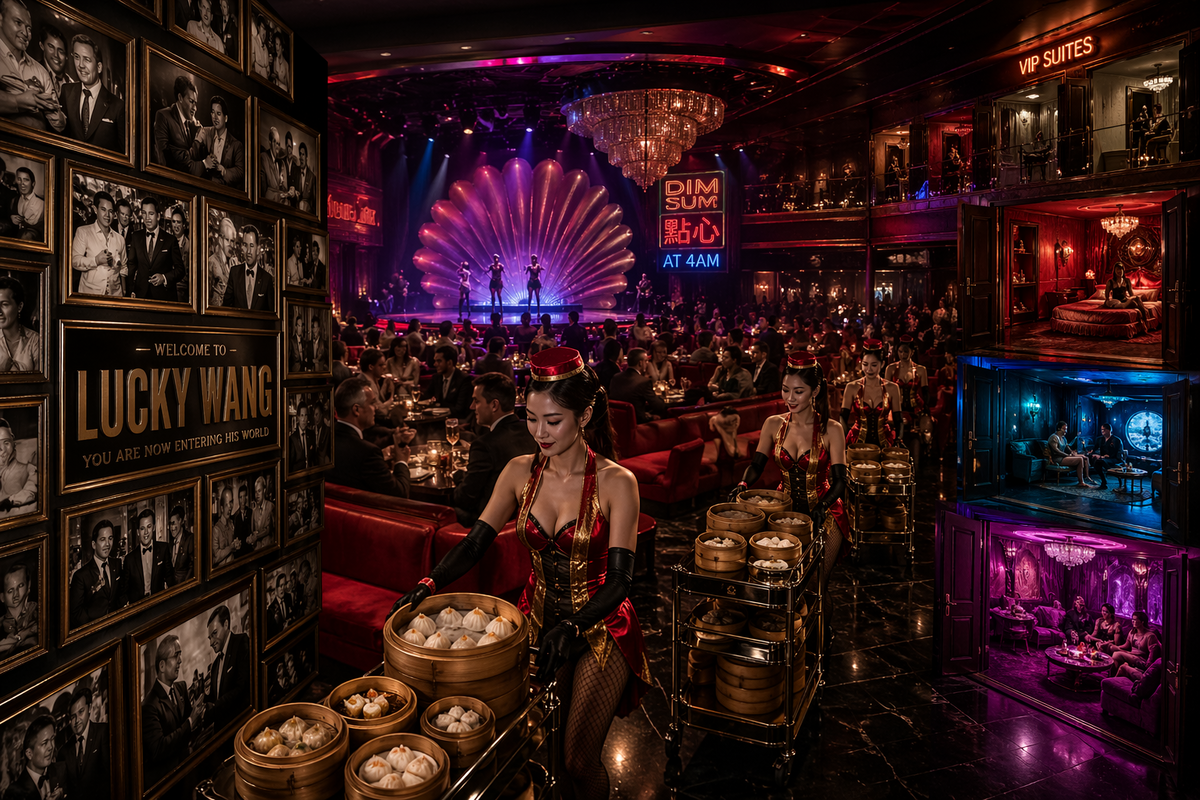
I want to spend a moment on this because it deserves one. We weren't just planning a nightclub. We had a vision. A fully realized, deeply specific, beautifully ridiculous vision.
Lucky Wang was a character we had invented. Forty years old. Ultra-successful. Asian playboy jet-setter. We were going to hire an actor to play him. Photograph him with celebrities and business titans, Forest Gump-style. Then plaster the entire entry hallway with those photos so that as you walked in, you learned who Lucky Wang was. You were entering his world. You were a guest at Lucky Wang's party.
Inside: plush booths, a clamshell stage, old-school Vegas energy. But the food. This is where it gets good. Dim sum. We were going to have waitresses in classic Vegas outfits pushing dim sum carts through a late-night after-hours club. I want you to sit with that image for a second. Pushing dim sum carts. At 4am. In Las Vegas.
Then upstairs, the entire floor of hotel rooms transformed into themed VIP experiences. Private rooms you could rent, each with your own wait staff and bottle service. Doors open or closed. Your own version of the night running in parallel with everyone else's. Like The Madonna Inn in San Luis Obispo, if The Madonna Inn were in Las Vegas and served dumplings at midnight.
We had scouted a location two buildings down from Drai's After Hours on East Flamingo. Ten thousand square feet of basement. The entire first floor of hotel rooms available for conversion. We liked the idea of competing directly with Drai's because that's how you become number one. You compete with number one. And you don't just do it better. You do it completely differently.
By late August 2001, we had an investor. A million dollars. A greenlight. Lucky Wang's Pussycat Lounge was going to happen.
Then came September 11th.
My girlfriend and I had decided not to have a TV in our apartment (a choice that feels both principled and insane in retrospect), so we heard about it on the radio. We spent the day in a nearby bar watching the coverage and trying to understand what we were looking at, along with everyone else in the world.
Las Vegas became a ghost town. Within two weeks, 100% of my catalog (list-brokering) clients had either cancelled or gone silent. I went from a salary to zero income in the span of a news cycle. The million-dollar investor put Lucky Wang on hold. He wanted to see what happened to the market first. Nobody knew what happened next.
There were rumors that the New Year's Eve celebration on the Strip was going to be hit by a biological attack. I don't know if those were credible or just fear talking. Either way, people were saying them out loud in public.
I was back at square one. Except this time I had more overhead and a girlfriend.
I want to be careful here because my problems were genuinely small next to what thousands of families were living through. The following year I went to New York for a convention. There was still smoke or steam rising from the hole in the ground where the towers had been. I've been back since to visit the memorial and the museum. It's one of the more quietly devastating places I've ever stood. If you haven't gone, go.
But I had to figure out what came next.
The nightlife chapter was closed. That was the last time I'd chase that particular kind of business. What I needed was something I could build from wherever I was, with whatever I had. I went back to the model I understood: lead generation.
Right around this time I met an email marketer. He showed me something I hadn't seen before. How to generate leads with email, at real scale. The cost to produce a legal services lead was $4.50. I ran the math about three times because I wanted to make sure I was reading it right.
I was.
That's when I started Leads to Wealth. By 2007 we were doing over $2 million a month. I sold it for seven figures. On purpose this time, not because the market evaporated while I was standing in it.
Here's the part I keep coming back to.
The dot-com crash sent me to Las Vegas. Las Vegas put me in a specific job. That job connected me to an investor who greenlit Lucky Wang. Lucky Wang died on September 11th. That pushed me back to lead generation at exactly the moment someone was ready to show me how to do it differently. If none of it had gone wrong, I would not have been in that room.
There's an old story about a man shipwrecked on a deserted island.
He salvages what he can and builds a small hut. It's not much but it's everything he has. One day he comes back from searching for food and finds the whole thing on fire. His shelter, his supplies, all of it.
He's not having a good afternoon.
Then a rescue ship appears on the horizon. They spotted the smoke. The disaster was the signal.
I think about that story a lot. Not because it means everything works out. It doesn't always, and I'm not going to tell you it does. But because of the question it leaves you with:
What did this make me find?
Stop asking what you lost. Ask what the loss made you find.
The dot-com crash forced a move. The move forced a job. The job put me in a room. Lucky Wang got killed and the room had someone else in it. Someone holding something I needed.
My thirty-year-old self, slowly sinking toward the floor of a Las Vegas living room at 3am, did not know any of this was coming.
He would have been annoyed to hear it.
He also would have been right.
Forward is the only direction worth spending real time in. Even when the mattress has a leak.
— Gil